Updated September 2026 for Nousfarer.
Land on the Classical Mechanics planet in Nousfarer and the trail takes you past its institutes in historical order. Newtonian Mechanics comes before Lagrangian Mechanics. It is tempting to read that order as a story of progress, with each new building making the last one obsolete. Usually it isn’t that simple.
A field can hold replaced theories, alternative formulations that stay useful, specialized branches, and live disagreements, all at once. So start small. Choose two approaches and ask how they relate. The answer changes what you should read next: a current introduction, a worked comparison, a specialist chapter, or opposing arguments about the same case.
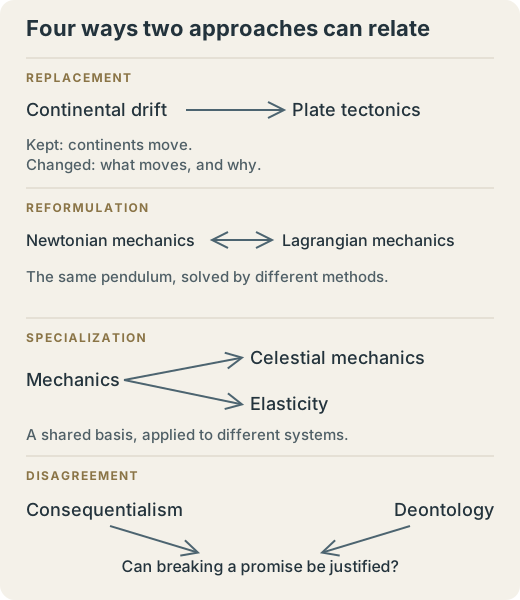
Four common relationships, with the examples below. The shapes suggest questions to investigate; they do not establish what happened.
Did one account replace another, and in what respect?
A later account can displace an earlier explanation while keeping some of its observations or techniques. Pin down the scope of the change before deciding what “replacement” means.
Continental drift and plate tectonics are a good example. The later framework kept continental movement but changed the account of what moves and how ocean floor forms and is recycled. Our essay on investigating historical change follows that distinction and its sources.
If you want to learn current geology, start with an introduction to plate tectonics, then look at what it changed. If you want to understand the earlier controversy, read the competing arguments in their historical context. Your purpose decides the route through the comparison.
Do these approaches express the same problems differently?
Alternative formulations can stay useful side by side. A new mathematical language can make a calculation easier or reveal a relationship that was hard to see before.
Newtonian and Lagrangian mechanics can both describe the same ideal pendulum. A Newtonian treatment starts with forces and acceleration, including the tension in the string. A Lagrangian treatment describes the pendulum with a single coordinate, its angle, builds the Lagrangian from its kinetic and potential energies, and derives the motion without first solving for that tension. Choosing good coordinates is possible in Newtonian mechanics too; the Lagrangian method makes it systematic. David Tong’s classical dynamics notes work through the comparison and the role of constraints.
On the planet the two stand as separate institutes, and that coexistence is a reason to compare methods, not a sign that the older one failed.
Pick a worked example presented both ways. Track which quantities each method introduces and how it reaches the result. If the second treatment gets hard, find the missing mathematics before moving to another example.
Do they specialize in different problems?
Specialization changes the focus of study. Within mechanics, celestial mechanics studies motion such as orbits, while elasticity studies how bodies deform. A shared foundation supports work on different kinds of systems.
For a beginner, asking which branch “won” misses the point. Ask what system you want to understand and which assumptions the specialist treatment makes about it.
If you want to know why a beam bends, choose an introductory treatment of elasticity and note the mechanics it assumes. A chapter on orbits serves a different purpose. Learn the shared principles you need, then follow the branch that addresses your problem.
Do they disagree about the same question?
Can breaking a promise be justified if it leads to a better outcome? An act-consequentialist judges the action by its consequences. A deontologist asks what obligation the promise creates and whether anything can override it. The Stanford Encyclopedia’s account of deontological ethics sets out the distinctions and the disagreements within both views.
Read both treatments with the same case in mind. Record the reason each gives, the circumstances it treats as relevant, and the objections it must answer. Two views can agree on a verdict for different reasons, and a disagreement can turn on the facts as well as on standards.
Coexistence does not mean equal evidence or equally strong arguments. A comparison should help you judge those differences; it need not end in a compromise.
Turn the comparison into a reading choice
These relationships overlap. An approach can reformulate shared principles and also grow into a specialization. Two rivals can agree on some questions. Read the framework introductions and the underlying literature before drawing conclusions from dates or shapes alone.
Any map of a field also selects. Its makers choose the boundaries, the labels, and which approaches get a building of their own. If your textbook gives a topic a whole chapter and the planet barely mentions it, investigate the difference: the topic may sit inside a broader institute, the two sources may organize it differently, or the map may have a gap.
Choose two approaches in a field that interests you, perhaps two institutes on the same planet, and complete this sentence:
These approaches appear to relate through ______, so my next reading will help me ______.
You might choose a successor’s explanation of a specific failure, one problem solved two ways, a specialist chapter, or two arguments about a disputed case. If you can’t yet name the relationship, make that uncertainty the question for your next source.
Read next: A Timeline Shows When. What Explains Why?, on investigating how and why approaches change.