Universities sort human knowledge by corridor. Physics lives in one building, philosophy across the quad, medicine by the hospital, economics behind a different reception desk. After enough years inside that arrangement, it is easy to mistake the campus map for the territory of thought itself.
We wanted to test what happens if you erase the department signs. Take all 24,824 conceptual frameworks currently catalogued across 2,097 subfields in the Noosaga Atlas—from classical mechanics and humoral medicine to participatory design and deontological ethics—and ask a single question: if each idea stands next to whatever it is actually about, what shape does human knowledge take?
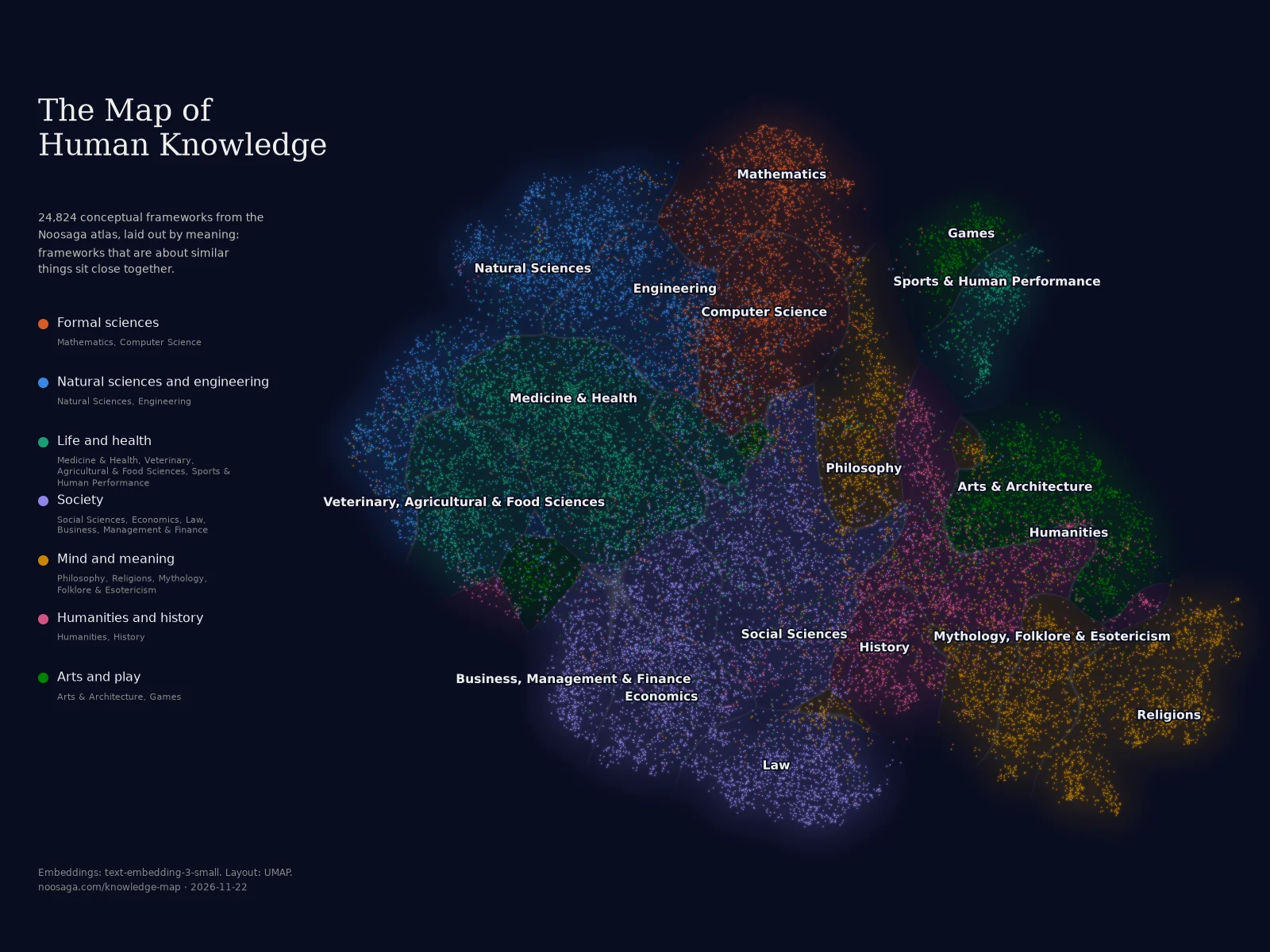
The result is The Map of Human Knowledge, an interactive continent you can search, zoom through across time, and light up with your own studies. Building it taught us as much about the traps of mapping ideas as about the ideas themselves.
The shortcut that cheats the map
Our first instinct—and the mistake almost every taxonomy visualiser makes—was to feed each framework's full path into the embedding model: its category, its discipline, its subfield, and its name.
The picture looked wonderfully tidy, and it was completely circular. When you tell an embedding model that a framework belongs to Natural Sciences → Physics or Law → Jurisprudence, the labels overwhelm the substance. In that early test, only 1.8% of frameworks found their nearest neighbour outside their own category. We had not mapped the structure of ideas; we had just drawn our own filing cabinet back to ourselves.
So we threw the department labels out. For the real map, every framework is represented strictly by its content: its name and aliases in subfield context (so Copenhagen School in security studies is not confused with linguistics), the sentences in its subfield overview that actually describe it, the opening of its matched Wikipedia article, and the concepts inside its curriculum where written. Never its discipline. Never its category.
A quarter of all neighbours cross borders
Once the filing labels disappeared, the neat islands dissolved into a single connected continent.
Measured in the full 1,536-dimensional embedding space, 25.4% of every framework's fifteen nearest neighbours sit in a different category. Roughly one framework in six (16.3%) has its single closest intellectual relative in another category altogether, and 4,363 frameworks have more neighbours outside their home category than inside it.
Some of those crossings look obvious in hindsight and startling on a map:
- Operational Research sits squarely on the frontier between Engineering and Business, Management & Finance.
- Embodied and enactive cognition bridges Philosophy directly into Social Sciences.
- Hilbert's program and metamathematics links Mathematics to Philosophy.
- Veterinary Public Health stitches Veterinary, Agricultural & Food Sciences directly onto Medicine & Health.
Even more telling are the 982 framework names that appear independently in multiple categories because several fields could not do their work without them. Functionalism shows up across 20 subfields in six categories; Humorism across 15 subfields in seven; Environmental Justice across 14 subfields in eight. Look at the overall continent and you can see Philosophy running vertically down the eastern centre like a spine, touching mathematics and computer science on one flank, social sciences and history below, and humanities and religions on the other.
Honesty about flattening 1,536 dimensions
Every world map lies about Greenland, and every two-dimensional projection of a high-dimensional embedding lies about distance.
To draw 24,824 points on a screen, we reduce the 1,536-dimensional vectors through PCA and UMAP, anchored to the previous published layout so redraws stay visually familiar as the Atlas grows. That projection captures broad geography well—you can see where formal sciences meet engineering and where medicine meets life sciences—but it cannot preserve every local neighbourhood faithfully. When we check the projection honestly, only about 22% of a point's fifteen closest neighbours on the 2D canvas are among its fifty closest in the full embedding.
That is why no finding on the page is ever measured from screen coordinates. Every neighbour share, bridge, and cross-category statistic on /knowledge-map is computed in the full 1,536-dimensional cosine space, and the method section publishes the projection's distortion numbers in plain sight. A map is useful only when it tells you where its own ink stops being exact.
Closeness in meaning is not ancestry
Embeddings have a second, subtler blind spot: they measure resemblance, not history. Two theories can share vocabulary without ever having met, while a fierce intellectual rebellion can change a field's vocabulary so thoroughly that parent and child end up neighbourhoods apart.
To show how ideas actually travel—not just which ones sound alike—we built a separate Lineage of Ideas alongside the map: 85,701 reviewed historical links connecting 17,211 frameworks across all 2,097 subfields. Instead of a single vague "related" arrow, each link names the relationship:
- 57,060 direct influences and 17,411 derivations
- 7,281 reactions against an earlier view and 2,019 live rivalries
- 982 supersessions and 948 later revivals
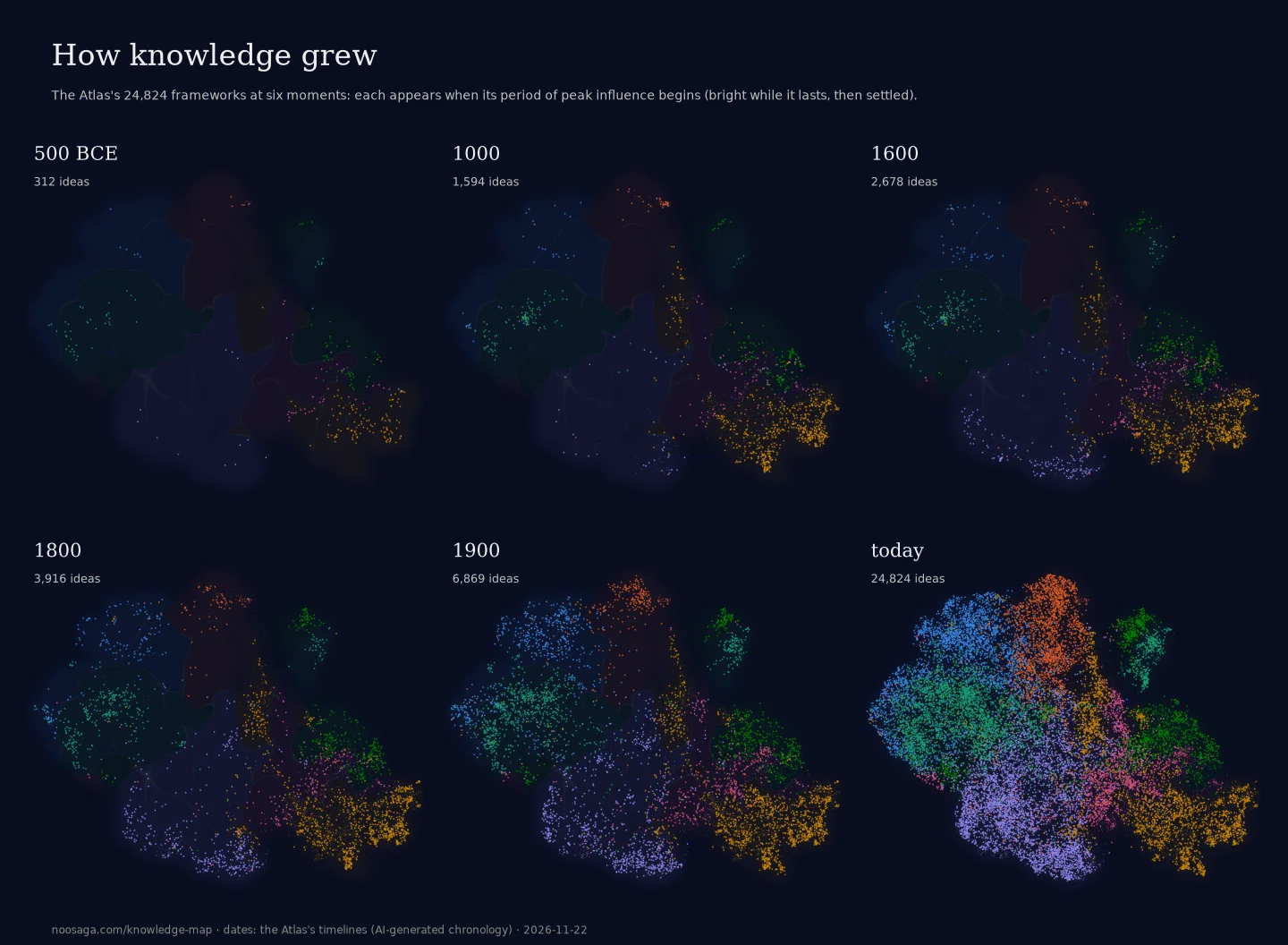
Paired with the Atlas's chronology, the static scatter turns into a living record. You can watch the continent ignite across six millennia—from 312 frameworks active by 500 BCE, concentrated in ancient religious, mythological, and early philosophical traditions, through 2,678 by 1600 and 6,869 by 1900, to the 24,824 frameworks of today. Trace the River downstream from a single turning point—Aristotelian natural philosophy reaching ten categories, Newtonian mechanics and Classical economics reaching seven, Germ theory of disease reappearing across twenty-one subfields—and you see immediately why no single discipline owns the history of an idea.
A map meant to be walked
A poster of human knowledge is nice to admire for two minutes; a map you can actually inhabit changes how you study.
Every point on The Map of Human Knowledge leads straight into its subfield in the Atlas, its Lineage River, and its Scholar's Tower in Nousfarer. When you sign in and switch to Your map, the towers you have climbed light up against the rest of the continent—turning a diffuse wish to "learn more" into a visible frontier of places you have stood and neighbouring territories waiting just across the border.
Open the map, pick a framework you thought belonged strictly to one subject, and follow its bridges into the next room. You will rarely walk very far before the department sign changes over your head.