THE MAP OF HUMAN KNOWLEDGE
Every idea in the Atlas, laid out by meaning.
20,718 conceptual frameworks from 1,879 subfields. Each point is one school, theory, method or tradition; ideas about similar things sit close together. Explore it, search it, and open any framework’s field.
Charting the frameworks…
Drag to move · Ctrl/⌘ + scroll or pinch to zoom · hover a point, click to pin it and see its closest ideas · play the history, or drag its slider · keyboard: arrows, + and −, 0, Enter
01 / HOW TO READ IT
Near means alike.
Each point is one conceptual framework in the Atlas, such as Newtonian Mechanics, Stoicism or Game Theory. We describe each by its name in the context of its subfield, with its key concepts and an excerpt of its article where the Atlas has them, and turn that description into an embedding: a list of 1,536 numbers that captures what the words are about (text-embedding-3-small). We leave out each framework’s discipline and category, so fields are not drawn apart by their labels alone.
UMAP then lays the embeddings out on a plane, keeping frameworks of similar meaning near each other as well as two dimensions allow (section 08 measures how well). Regions and neighbourhoods are meaningful; the axes are not, and the distance between two far-apart regions is only a rough guide. Colour shows seven families of categories, and every category is named on the map. The faint lands are their territories: where each category is the most common kind of idea, its name at its densest place. All the numbers below are measured in the full embedding, not on the flattened map.
02 / HOW KNOWLEDGE GREW
Ideas have dates.
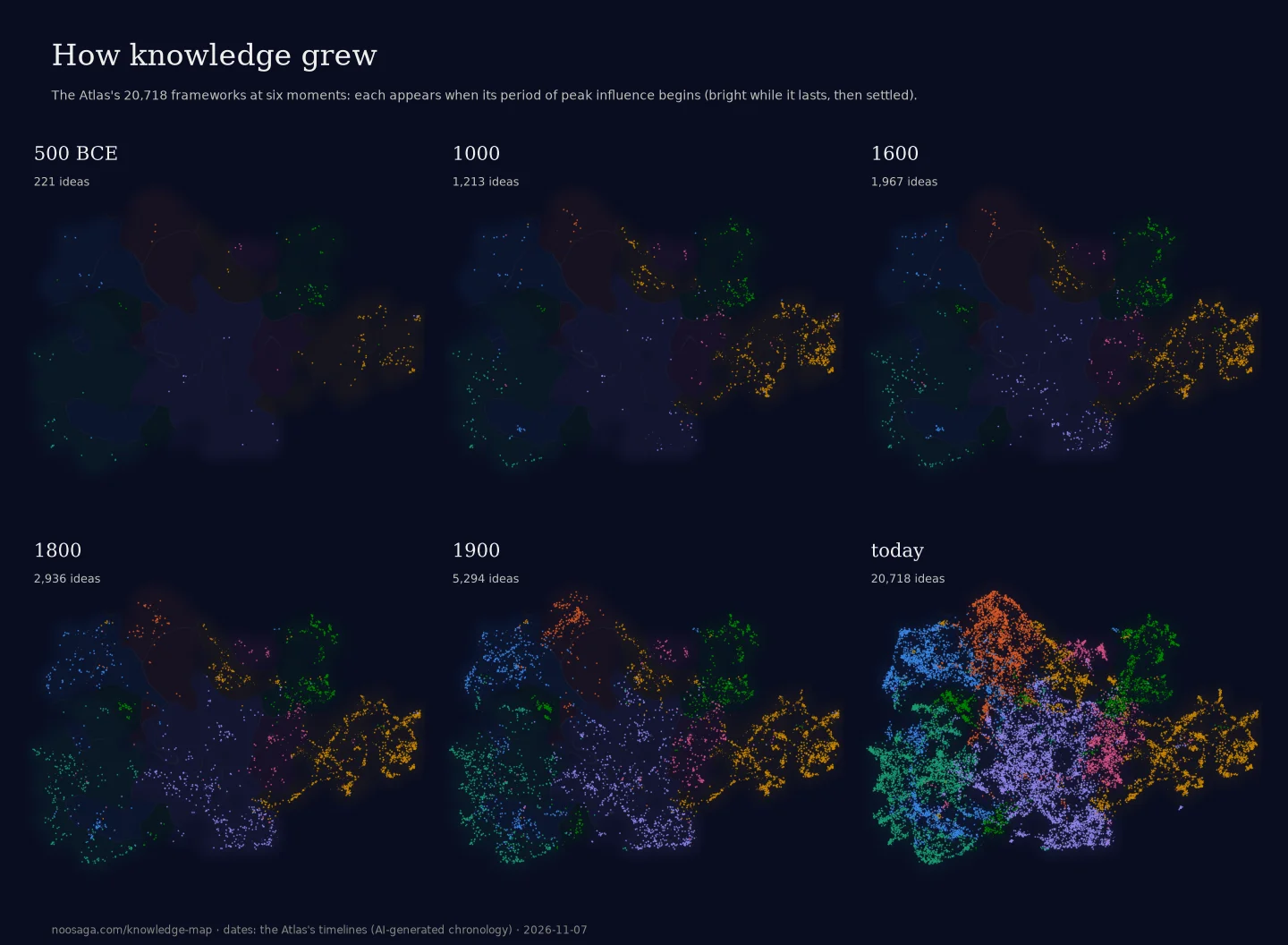
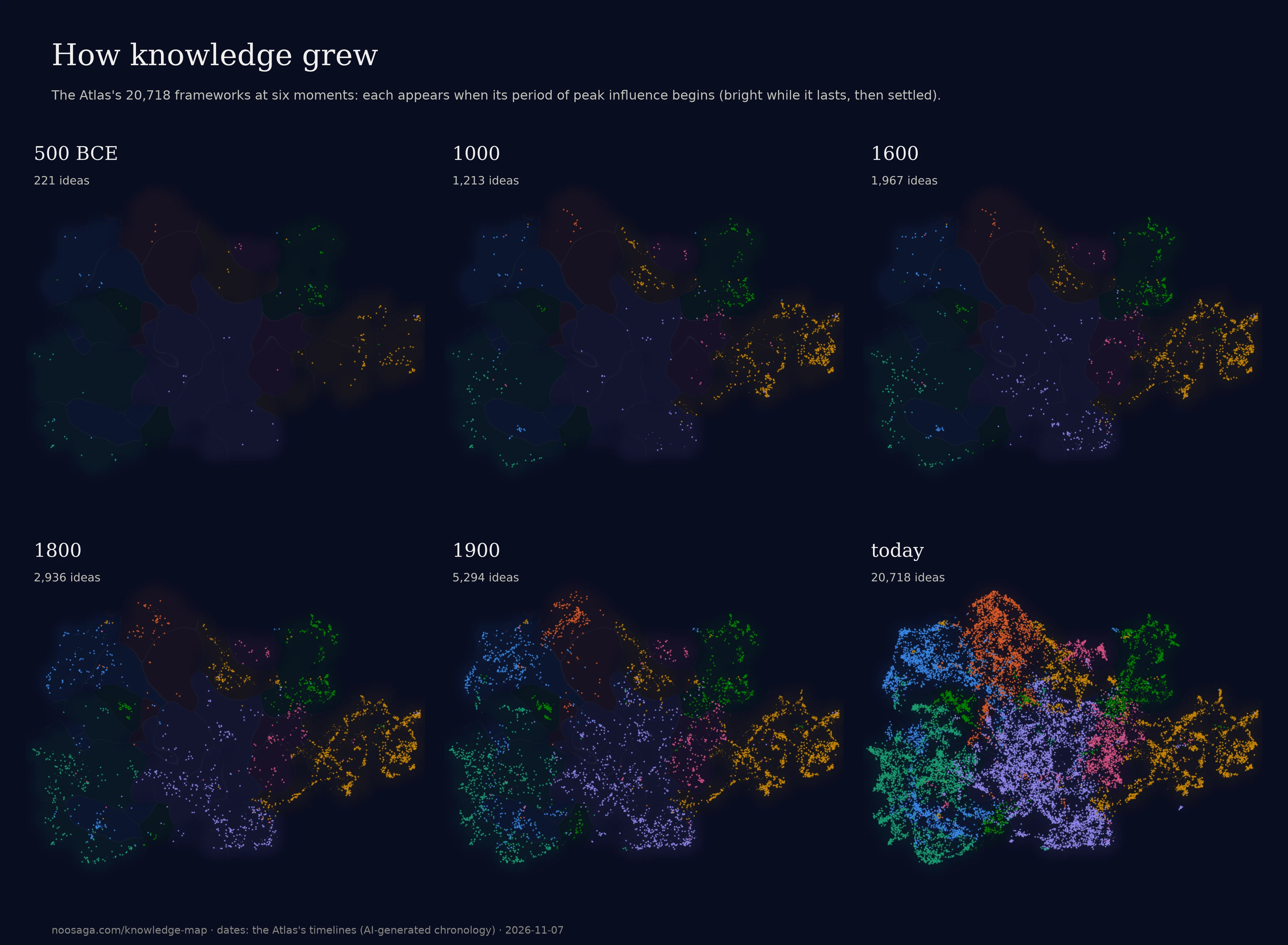
Play the history on the map: each framework appears when its period of peak influence begins on its subfield’s timeline, glows while that period lasts and then settles into the canon. The dates are the Atlas’s own chronology, written with the help of AI and mostly marked as broad, so read them as eras rather than exact years.
Knowledge is young. 77% of the Atlas’s frameworks begin after 1900, and half of them after 1963. The oldest:
- Prehistoric and Ancient Near Eastern Art · 40,000 BCE Arts & Architecture
- Carving · 30,000 BCE Arts & Architecture
- Rock Art · 30,000 BCE Arts & Architecture
- Aboriginal Australian Painting · 20,000 BCE Arts & Architecture
- Traditional ceramic craft tradition · 20,000 BCE Natural Sciences
When each field formed
The year a quarter of each category’s frameworks had appeared, on the slider’s scale of eras.
- Religions690
- Mythology, Folklore & Esotericism1230
- Philosophy1690
- Arts & Architecture1837
- Law1868
- Veterinary, Agricultural & Food Sciences1900
- Natural Sciences1912
- Mathematics1920
- Games1920
- History1929
- Medicine & Health1933
- Engineering1934
- Humanities1944
- Social Sciences1945
- Sports & Human Performance1950
- Business, Management & Finance1950
- Economics1950
- Computer Science1974
When fields met
Two fields meet when a framework of one has at least 5 of its 15 closest ideas in the other (and at least 3 such frameworks join them). 85 pairs of fields have met; the first:
- c. 20,000 BCE · Traditional ceramic craft tradition Natural Sciences and Arts & Architecture
- c. 7,000 BCE · Fermentation Craft Tradition Natural Sciences and Veterinary, Agricultural & Food Sciences
- c. 5,000 BCE · Craft and empirical processing traditions Engineering and Natural Sciences
- c. 3,500 BCE · Sign and Symbol Systems Social Sciences and Arts & Architecture
- c. 3,000 BCE · Empirical craft tradition Engineering and Arts & Architecture
- c. 1,800 BCE · Classical Numerical Procedures Computer Science and Mathematics
- c. 1,500 BCE · Vedic sacrificial mythology Mythology, Folklore & Esotericism and Religions
- c. 800 BCE · Vedāntic and Buddhist Meditative Analysis Philosophy and Religions
03 / BORDERS, NOT WALLS
Fields meet at their edges.
For 9% of frameworks, the single closest idea in the whole Atlas belongs to another category, and 14% of their 15 nearest neighbours do. Some ideas sit right on a border: at least 5 of their 15 closest relatives in their own category and as many in one other. 2,094 frameworks do; here is one for each pair of fields, the most clearly placed first.
- Cognitive Psychology · Cognitive Neuroscience Natural Sciences and Social Sciences
- Quantum Computation · Quantum Information Natural Sciences and Computer Science
- Veterinary Public Health · One Health Veterinary, Agricultural & Food Sciences and Medicine & Health
- Participatory Design · Design Arts & Architecture and Computer Science
- Confucianism · History / Chinese Philosophy Philosophy and Religions
- Experimental Fluid Dynamics · Fluid Dynamics Natural Sciences and Engineering
- Logicism · Mathematical Logic Mathematics and Philosophy
- Old Institutional Economics · Institutional Economic History History and Economics
- Psychoanalysis and Psychodynamic Therapy · Clinical Psychology Social Sciences and Medicine & Health
- Environmental and Ecotoxicology · Toxicology Medicine & Health and Natural Sciences
- Doing Gender · Gender And Sexuality Social Sciences and Humanities
- Legal Anthropology · Law and Society Law and Social Sciences
04 / SHARED IDEAS
One idea, many homes.
527 frameworks appear under the same name in more than one category. Intersectionality is studied in 7 categories and 15 subfields, more than any other. Each field tells such an idea’s story from its own side, which is why the Atlas keeps one in every field where it belongs.
- Intersectionality · 7 categories, 15 subfieldsHistory, Humanities, Law, Medicine & Health, Philosophy, Social Sciences, Sports & Human Performance
- Environmental Justice · 6 categories, 7 subfieldsArts & Architecture, History, Medicine & Health, Natural Sciences, Philosophy, Social Sciences
- Structuralism · 5 categories, 17 subfieldsEconomics, Humanities, Mythology, Folklore & Esotericism, Philosophy, Social Sciences
- Connectionism · 5 categories, 12 subfieldsComputer Science, Humanities, Natural Sciences, Philosophy, Social Sciences
- Functionalism · 4 categories, 21 subfieldsLaw, Mythology, Folklore & Esotericism, Philosophy, Social Sciences
- Actor-Network Theory · 4 categories, 14 subfieldsBusiness, Management & Finance, History, Philosophy, Social Sciences
- New Institutional Economics · 4 categories, 9 subfieldsEconomics, History, Law, Social Sciences
- Constructivism · 4 categories, 8 subfieldsArts & Architecture, Mythology, Folklore & Esotericism, Philosophy, Social Sciences
05 / OUTWARD AND INWARD
Some disciplines look outward.
The share of each discipline’s nearest neighbours that lie in other categories (disciplines with at least 20 frameworks). The outward ones sit where two fields share their questions; the inward ones are traditions with a language of their own.
Most outward
- Health Economics 39%Economics, reaching Medicine & Health and Business, Management & Finance
- Industrial Organization 39%Economics, reaching Business, Management & Finance and Law
- Cultural Studies 38%Humanities, reaching Social Sciences and Arts & Architecture
- Industrial Engineering 38%Engineering, reaching Business, Management & Finance and Mathematics
- Artificial Intelligence 38%Computer Science, reaching Engineering and Social Sciences
- Plant Pathology 33%Veterinary, Agricultural & Food Sciences, reaching Natural Sciences and Medicine & Health
- Cognitive Science 32%Social Sciences, reaching Philosophy and Natural Sciences
- Digital Humanities 32%Humanities, reaching Social Sciences and History
- Environmental History 31%History, reaching Natural Sciences and Social Sciences
- Historiography 31%History, reaching Humanities and Philosophy
Most inward
- Baha'i Faith 0.1%Religions
- Sikhism 0.2%Religions
- Number Theory 0.4%Mathematics
- Video Games 0.7%Games
- Emergency & Critical Care 0.8%Medicine & Health
- Shinto 0.9%Religions
- Magic & Witchcraft Studies 1.0%Mythology, Folklore & Esotericism
- Football Codes 1.0%Sports & Human Performance
- Cultural Astronomy & Astrology 1.1%Mythology, Folklore & Esotericism
- Card Games 1.2%Games
06 / BREADTH
How wide is a field?
The average distance of a category’s frameworks from its own centre (cosine distance in the embedding): the larger, the more different kinds of idea the field holds. Beside each, the category whose ideas are closest to it.
07 / THE MAP AS A TABLE
Families and categories.
| Family | Category | Frameworks | Neighbours elsewhere |
|---|---|---|---|
| Arts and play | Arts & Architecture | 1,690 | 10% |
| Arts and play | Games | 373 | 7% |
| Formal sciences | Computer Science | 1,061 | 20% |
| Formal sciences | Mathematics | 1,053 | 12% |
| Humanities and history | Humanities | 867 | 18% |
| Humanities and history | History | 755 | 19% |
| Life and health | Medicine & Health | 1,991 | 11% |
| Life and health | Veterinary, Agricultural & Food Sciences | 1,037 | 11% |
| Life and health | Sports & Human Performance | 463 | 14% |
| Mind and meaning | Philosophy | 1,343 | 16% |
| Mind and meaning | Religions | 1,286 | 6% |
| Mind and meaning | Mythology, Folklore & Esotericism | 666 | 7% |
| Natural sciences and engineering | Natural Sciences | 1,829 | 14% |
| Natural sciences and engineering | Engineering | 927 | 25% |
| Society | Social Sciences | 1,830 | 20% |
| Society | Business, Management & Finance | 1,310 | 17% |
| Society | Economics | 1,142 | 21% |
| Society | Law | 1,095 | 11% |
08 / HOW FAR TO TRUST IT
Measured in meaning, drawn in two dimensions.
Every number on this page is measured in the embedding itself, where each framework is a point in 1,536 dimensions, never on the drawing. The numbers do depend on how wide a circle of neighbours counts: the wider the circle, the further it reaches into other fields.
- 5 closest9% in another category
- 10 closest11% in another category
- 15 closest (used here)14% in another category
- 25 closest19% in another category
- 50 closest26% in another category
The map itself is a flattening, and a flattening must tear somewhere. Of the 15 frameworks nearest a point on the map, on average 48% are among its 50 closest in meaning, and laying the map out again from another random start keeps 43% of them. So read a point’s surroundings as a rough guide; its list of closest ideas (pin it on the map) comes from the embedding and is exact.
When the Atlas grows, the map is redrawn starting from its last layout, new frameworks beside their closest relatives, so the places you know stay roughly where they were.
09 / TAKE IT WITH YOU
The poster.
The whole map as a still image, 6000 × 4500 pixels, for printing, slides and papers.
Download the poster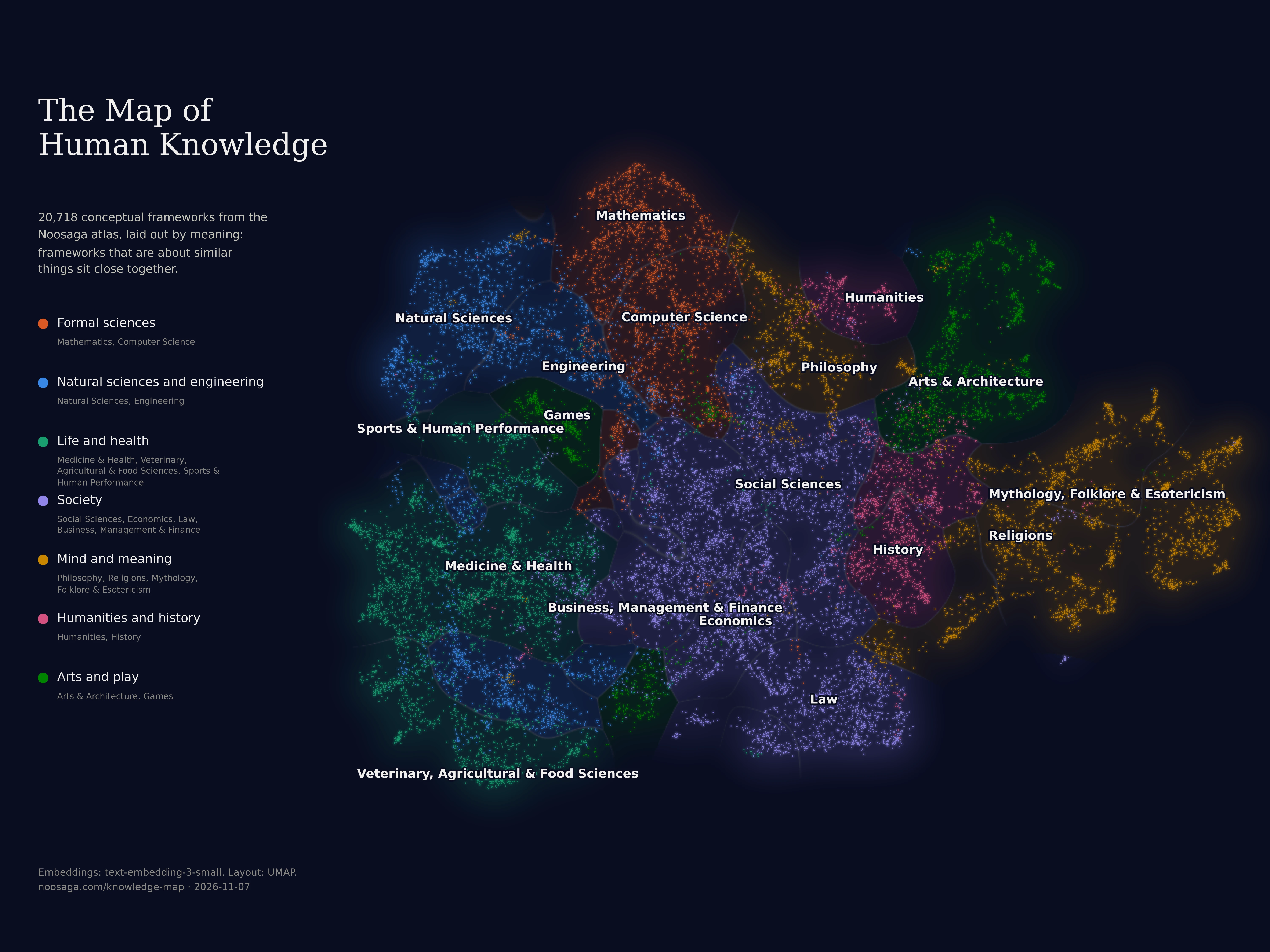
Drawn on 2026-11-07 from the Atlas’s 20,718 visible frameworks; it is redrawn as the Atlas grows. Embeddings describe ideas the way language does, with the gaps and leanings of the text a model learned from; frameworks the Atlas knows only by name are placed by their name and field. Read it as a portrait of the Atlas, not a ruling on how ideas relate.